You may have come across eco-friendly hosting in a conversation about cloud performance or sustainability in tech. Some readers already understand the basics, while others are exploring this topic for the first time because this term is appearing more often in hosting and infrastructure discussions.
That curiosity is not random.
Data-centre electricity use continues to rise as AI workloads, automation, cloud adoption, and media-rich websites expand. According to the International Energy Agency estimates that global consumption could reach around 945 TWh by 2030, which is why sustainability is entering hosting decisions more seriously today
Making eco friendly web hosting as a part of how modern hosting environments are planned, powered, and optimised. And before going deeper into why this shift is happening, it helps to understand what actually defines eco friendly hosting in practice, not just the idea of “green charging”, but the infrastructure decisions that sit underneath
What makes hosting “eco-friendly” today?
Eco-friendly hosting is not just about placing servers in a data centre that buys renewable credits. The real shift happens at the infrastructure level, in how power is sourced, how cooling is handled, and how hardware usage is optimised. That is where the difference shows up in practice.
For many people new to this space, the natural question becomes: how does green hosting actually work inside a real environment?
It usually comes down to a few core choices:
- Cleaner power inputs
More hosting setups now run on solar, hydro, or wind power. For example, many green hosts use data centers where 100% of the electricity is matched with renewable energy certificates or sourced directly from on-site solar fields. - Better hardware efficiency
Modern infrastructure focuses on doing more with less power. A common example: moving from older spinning-disk servers to SSD-based systems, which deliver faster performance while using significantly less energy. - Improved cooling design
Cooling often consumes a huge share of data-center energy. Newer facilities use liquid cooling, hot aisle/cold aisle layouts, and even redirect excess heat to warm nearby buildings, all of which cut energy waste. - Less idle capacity
Instead of letting servers sit half-empty, green hosts optimize for higher utilization. A real example is auto-scaling, where servers spin up only when needed and shut down during low demand, so power isn’t used on quiet workloads.
All of this is what makes sustainable web hosting meaningful in real use, which is where real environmental impact (and cost impact) happens and not just in marketing.
Why are people shifting to eco friendly hosting?
The rise of eco friendly hosting is not only happening because providers are updating their infrastructure. There is a noticeable mindset shift in how hosting decisions are being made. People no longer see hosting as just “server space.” It is becoming part of how digital work connects to energy, cost, and future direction, and that is where sustainable web hosting slowly enters everyday thinking.
This shift is influenced by a few key patterns:
Why are hosting companies focusing on sustainability now?
On the provider side, this shift has less to do with marketing and more to do with pressure points inside their infrastructure business model. Data-centre operators are feeling the weight of higher power density hardware, GPU-heavy workloads, and unpredictable capacity demand.
So what’s pushing these changes:
- GPU clusters for AI training generate far more heat than standard CPU-based hosting.
- Some regions now require data-centre energy reporting as part of regulatory compliance, which means transparency is no longer optional, etc
These reasons prompt hosting companies to redesign their infrastructure because the next decade of scale requires energy-aware architecture instead of compute growth with unmanageable ROI.
Key trends shaping eco-friendly hosting in 2026
When the conversation moves from “awareness” to actual industry behaviour, the next layer becomes the patterns that are actively shaping eco friendly hosting today. These are not random upgrades or one-off improvements; they show where hosting infrastructure is actually heading.
1) Liquid cooling is moving beyond hyperscaler – Until recently, liquid cooling was something only hyperscale providers like Google or AWS used. But GPU-heavy AI workloads have changed that. Now, even mid-tier data centers, including providers like DigitalOcean and OVHcloud, are adopting liquid cooling for better thermal management.
2) Server heat is being reused instead of being wasted
In Finland, Fortum uses data-center waste heat to warm around 25,000 homes in the Helsinki region, turning a cooling challenge into a valuable energy source.
3) Carbon transparency is becoming a UX layer
Instead of hiding sustainability data in PDFs or reports, some providers now show energy or carbon signals inside dashboards, making sustainability part of the hosting experience.
4) Renewable contracts act as cost stabilisers
Providers are using long-term solar, wind or hydro contracts to reduce energy volatility, so eco-friendly decisions support cost predictability, not just branding.
5) Performance per watt is a brag metric now
The industry is shifting from “bigger servers = strength” to “better output per watt used,” becoming a competitive feature.
What this shift means for the hosting market moving forward
The rise of eco-friendly hosting is changing how hosting is evaluated, compared, and purchased. It’s no longer only about speed, RAM, storage, or entry price. The competitive layer underneath hosting is shifting , slowly, but clearly.
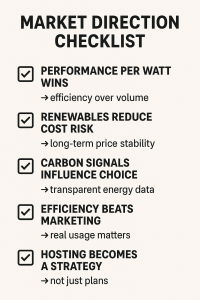
What to check before buying your eco friendly hosting?
When you look at eco friendly hosting options, the label alone is not enough. Your clarity depends on what sits under the hood, not just how the provider presents themselves. This is the point where you need to shift from curiosity to evaluation, and want to understand whether eco friendly hosting actually delivers the value that it claims sustainability.
- Is the primary power source renewable, or are they mostly leaning on carbon offsets?
- What cooling model do they use, because this directly impacts operating energy load?
- Can you see any carbon or energy signals in your own dashboard, not in PDFs?
- Is their hardware utilisation optimised, or do they still run idle capacity that wastes power while calling themselves green?
- Does your sustainability help stabilise cost over time, or is it simply an expensive “green add-on”?
Conclusion
Eco friendly hosting is now a part of a bigger shift in how the internet is built. The decision is no longer about “green branding”, it’s about whether the infrastructure underneath websites is prepared for the next cycle of compute demand. And your hosting choices made today will define how resilient your digital products feel tomorrow.
The next wave of digital performance is being built now. Start your shift toward sustainable website hosting service St. Louis and strengthen your foundation for the future.