Cheap hosting sounds like a smart way to cut costs, until your site slows down, crashes, or hits you with a renewal fee that’s three times higher.
Most “budget” hosting plans look great on paper. You get a website online for a few bucks a month, and it feels like a win, until traffic grows, or you run a big campaign and realize your hosting can’t keep up.
What many people don’t see are the hidden trade-offs: limited bandwidth, poor support, surprise charges for backups or SSL, and servers so crowded they struggle to stay online. It’s not just about speed, cheap hosting can quietly cost you conversions, SEO rankings, and customer trust.
All these hidden costs add up – slow speeds here, a renewal fee there, and before you know it, you’re spending more to stay online than you saved.
If you’ve ever had your site go down during a big sale or a product launch (think Black Friday traffic), you already know what “cheap” really costs. And, here’s how to spot (and avoid) those traps before they hit your budget or your site performance.
Checklist: How to Avoid Hosting Hidden Fees Before You Buy
Before committing to any hosting plan, use this checklist to identify potential hidden costs:
Pre-Purchase Questions to Ask
- What’s the renewal price after the first year? Intro rates often increase by 60-100%
- Are SSL certificates included? Or will I pay $50-100/year extra?
- What’s included in “unlimited”? Check bandwidth caps, storage limits, and CPU restrictions
- Is there a backup solution? Many cheap hosts charge $2-5/month for automated backups
- How many email accounts are included? Additional accounts often cost $1-3 each per month
- What level of support comes standard? Live chat and phone support may require premium upgrades
- Are there migration fees? Some hosts charge $100+ to move your site
- What happens if you exceed resource limits? Understand overage charges before you need them
Red Flags That Signal Hidden Costs
- Prices that seem “too good to be true” (usually under $3/month)
- “Unlimited everything” claims without clear usage policies
- No transparent pricing page or hidden renewal rates
- Separate charges for basic features (SSL, CDN, staging sites)
- Aggressive upselling during checkout
1. Every Minute Down Is Money Lost
When your website goes offline, your business loses visibility, revenue, and trust. The result? More frequent downtime and slower recovery when it matters most.
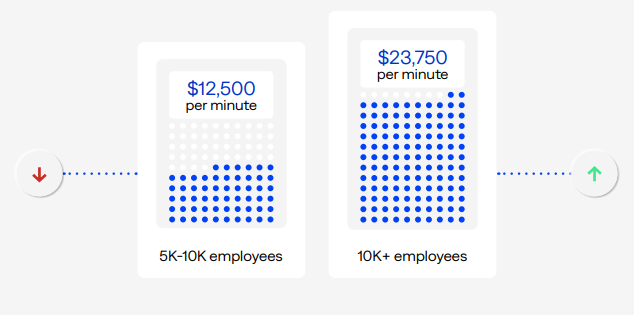
A recent study shows that the average cost per minute of downtime has increased by 65% for mid-sized organizations. Even larger enterprises, equipped with in-house IT and redundancy systems, only see a 5% decrease in per-minute losses.
Now consider this on a smaller scale. If your site generates $100 per hour and goes offline for three hours, that’s $300 in immediate lost sales, not counting abandoned carts, missed leads, or frustrated customers who may never return.
This is one of the most significant hidden costs of cheap hosting – the loss of revenue and reliability when your website isn’t operational.
The Impact of Downtime
- Lost revenue: Direct sales that never happened
- SEO penalties: Google downgrades sites with poor uptime
- Customer trust: 88% of users won’t return after a bad experience
- Competitor advantage: Your downtime is their opportunity
2. Poor Support Wastes Time
When your website slows down or goes offline, every minute counts. Quick, reliable support can be the difference between a short hiccup and hours of lost business. But with cheap web hosting, support is usually the first thing to get compromised.
To keep costs low, providers cut corners, have fewer support agents, limit live chat hours, and have long ticket queues. What follows is one of the most frustrating cheap hosting disadvantages: waiting.
A problem that could be fixed in minutes with a responsive team can drag on for hours or days, while your site remains inaccessible and your customers move on.
Now picture this during a high-traffic campaign, like a Black Friday sale. Your site is handling double its usual traffic, checkout pages are lagging, and then an error appears. You reach out to support, only to get an automated response or a promise of help “within 24 hours.”
That delay shows how cheap hosting affects website performance and directly impacts your business operations.
What Budget Hosting Support Actually Looks Like
- Ticket-only support with 24-48 hour response times
- Limited knowledge base that doesn’t cover complex issues
- Outsourced support teams without access to server-level tools
- No emergency escalation for critical downtime situations
- Community forums as primary support channel
3. Growth Exposes the Paywall
As your site begins to grow, you start hitting invisible limits, and every new feature suddenly has a price tag attached.
Common “Upgrade Required” Triggers
- Need more bandwidth to handle traffic? Upgrade.
- Want daily backups or extra email accounts? Upgrade.
- Adding staging environments or database access? Upgrade.
- Exceeding storage or CPU limits? You guessed it, Upgrade.
Reliable hosting providers don’t charge you for growing; they support it with transparent pricing that only increases when your website truly succeeds.
4. The Real Cost of Weak Security
Many cheap web hosting providers advertise low prices by skipping essentials like SSL certificates, daily backups, and malware protection. On shared servers, one compromised site can expose others, a risk that grows as your business expands.
Security Vulnerabilities in Budget Hosting
- No included SSL/HTTPS: Critical for SEO and customer trust
- Manual or paid backups: Disaster recovery becomes your responsibility
- Limited or no malware scanning: Infections spread undetected
- Shared IP addresses: Your reputation is tied to neighboring sites
- Outdated server software: Security patches delayed or skipped
How Budget Hosting Can Impact the Business
- Damage your SEO rankings (Google blacklists compromised sites)
- Cause extended downtime during cleanup
- Erode customer trust and brand reputation
- Result in costly recovery and remediation
For small businesses, these impacts could be a disaster – losing credibility and paying more to fix what could’ve been prevented.
5. Low Monthly Rates
If your hosting plan promises everything for just a few dollars a month, ask yourself, what are the hidden costs of cheap hosting behind that offer? Low-cost plans often hide their profits in add-ons. You’ll pay extra for email accounts, SSL, storage, or priority support. And once the first-year discount ends, renewals jump 60–100%. These cheap hosting hidden fees quietly turn “affordable” hosting into a long-term expense.
Let’s consider a real-time scenario: A local photography business signed up for a $2.99 plan. Within months, performance issues and limited storage pushed them into multiple upgrades. By renewal, their costs had tripled, more than what a transparent mid-tier host would’ve charged. That’s how budget hosting risks show up: not as errors or downtime, but as quiet expenses that stack up until the deal no longer makes sense.
6. Cheap Hosting vs. Reliable Hosting
At first glance, cheap hosting vs reliable hosting doesn’t look that different, both advertise speed, uptime, and “unlimited” plans. But the gap lies in infrastructure, support quality, and long-term value.
Comparison
| Feature | Cheap Hosting | Reliable Hosting |
|---|---|---|
| Server Resources | Overcrowded, shared limits | Dedicated or isolated resources |
| Support | Ticket-only, 24–48hr response | Live chat, phone, priority assistance |
| Security | Basic or paid add-ons | Included SSL, backups, and monitoring |
| Pricing | Low intro, high renewals | Transparent, predictable costs |
| Scalability | Hidden upgrade fees | Easy growth options |
| Uptime | 95–98% (frequent issues) | 99.9%+ with SLA guarantees |
Conclusion: Invest in Hosting That Supports Your Growth
You’ll know it’s time when your website feels slower than your business goals. Frequent downtime, delayed support, and constant upgrade prompts aren’t “normal”, they’re warning signs that your hosting is holding you back.
Because a good hosting doesn’t make you wait, patch, or pay more just to stay online. It grows with you, protects your data, and gives you time to focus on customers, not server issues.
So are you ready to make a change? Our website hosting services in St. Louis can help you move to a reliable, secure hosting environment. Because a smooth switch today can save you countless headaches tomorrow.